South Korea’s democratic image contrasts starkly with its stringent defamation laws, which have long been tools of censorship and intimidation against journalists.
The Constitution guarantees freedom of expression. But defamation laws here carry penalties that include prison — up to three years for comments that are true and up to seven for statements considered false — if they are deemed not in the public interest. Critics say the distinction is vague and opens the door to abuse by prosecutors.
Last year, the United Nations Human Rights Committee warned against South Korea’s “increasing use of criminal defamation laws to prosecute persons who criticize government action.”
The presidential office rejected such criticism, saying all democratic rights were protected.
“The government is especially sensitive about defending the personal reputation of the president,” said Park Kyung-sin, a professor of law at Korea University who has researched the issue.
Truth is not always a defense; even accurate reporting can lead to criminal penalties if deemed not in the “public interest.” This legal framework creates a chilling effect on investigative journalism, particularly on topics like political corruption and abuse of power.
Journalists face growing pressure under President Yoon Suk-yeol’s administration, which critics argue is increasingly intolerant of dissent. The government’s alignment with powerful media conglomerates connected to the People Power Party (PPP) raises concerns about biased reporting and self-censorship.
A protester raises a sign demanding an election audit as thousands of others chant in support of President Yoon.
Chojoongdong and chaebols
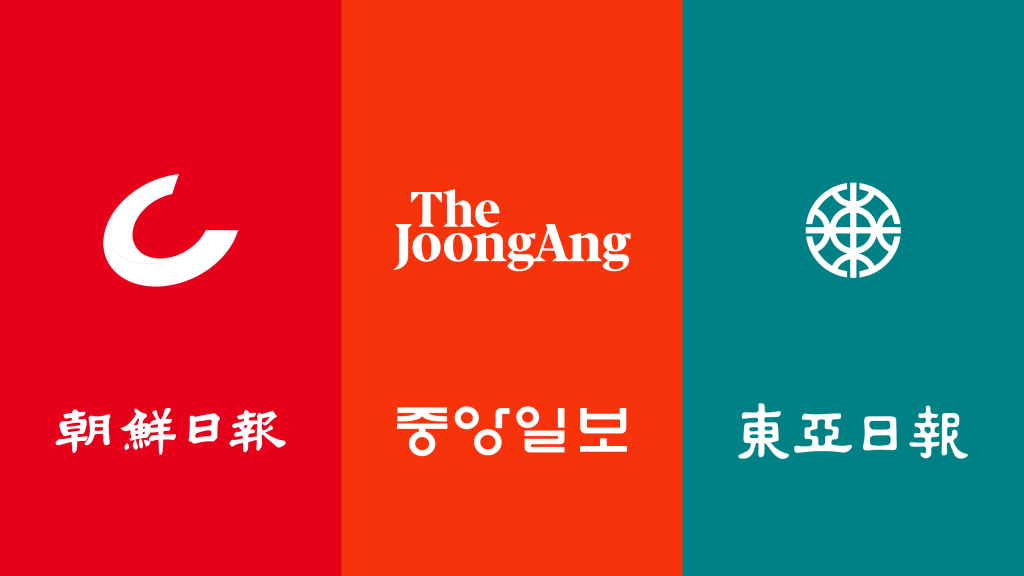
A notable example is the term “Chojoongdong,” which amalgamates the names of the Choseon Ilbo, Joongang Ilbo, and Dong-a Daily. These outlets dominate the media landscape, wielding significant influence over public opinion. Critics argue that their conservative bias and close relationships with political entities, particularly the People Power Party (PPP), result in reporting that aligns with government perspectives, marginalizing dissenting voices and alternative viewpoints.
The three major media outlets of Korea.
This is further compounded by a media reform bill passed by the Korean National Assembly in July 2009. The bill allowed dailies and news agencies to operate television businesses. More strikingly, it also allowed for private companies to own up to 20% of terrestrial television businesses and 30% of comprehensive programming businesses.
The recent privatization of YTN, a prominent news channel, further exemplifies the challenges faced by independent journalism. The privatization process has sparked debates about potential increases in pro-government bias, as ownership by the “Eugene Group” conglomerate (ranked 78th in the top performing corporations in the world) may prioritize political alignment over journalistic integrity.
The Eugene Group is a chaebolconglomerate. Samsung is the prime example of a chaebol, one of the massive family-run conglomerates that are credited with leading the country through its postwar surge from an impoverished country to an economic powerhouse. The political heft and outsized economic importance of these chaebols means they are “too big to jail.”
These intricate ties between media ownership, chaebeol conglomerates’ financial interests, and political affiliations cultivate an environment that often favors pro-government narratives, constricting independent journalism.
Their stories.
Journalists like Seung Gil Lee and Shin Kyung Rim, who have faced legal threats for their investigative work, emphasize the high stakes of defamation suits.
Fear of litigation discourages critical reporting.
Seung Gil Lee, professor of journalism
“Fear of litigation discourages critical reporting,” says Seung Gil Lee, a professor of journalism at Yonsei University. Lee was heavily pressured—and in his words, threatened—to take down a piece criticizing the past Park administration’s treatment of the Sewol Ferry tragedy.
This sentiment is echoed in South Korea’s declining position on the World Press Freedom Index, where the country ranked 62nd in 2024, a significant drop from 47th the previous year.
Despite the drop in press freedom, the government’s use of the laws against critics predates recent presidencies. During the five-year tenure of president Lee Myung-bak, 30 such cases were filed, 24 of them criminal and six civil, according to the People’s Solidarity for Participatory Democracy (an influential South Korean civic group.)
Under previous President Park Geun-hye, this leverage of defamation laws increased considerably, with 22 cases filed in her first two and a half years in office, the group said. Of those, 18 were criminal prosecutions. Current president Yoon Suk Yeol brings this number up to 35, with 16 criminal prosecutions.
The legal threats extend beyond lawsuits. Government oversight mechanisms, including the Korea Communications Commission, have tightened regulations on digital news platforms, restricting the flow of information.
“People are lamenting that there are no watchdogs, but only dogs,”
Park Sung-su, activist
Park Sung-su made use of the same metaphor after police officers raided his home for leading an anti-Yoon protest.. He called them “running dogs for the government,” later throwing dog food at the gates of police stations. In April of 2016, he was arrested on the charge of staging an illegal rally and then interrogated after he and several other activists had shouted, “Bow wow!” in front of a prosecutors’ office.
“They kept asking me what the political meaning of ‘bow wow,’ was,” he said. “It just means I’m sick of the dogs.”

 MunhwaMetrics